
For many business owners, zoning is an afterthought—until it becomes a problem.
Warehouses are often leased under the assumption that “industrial is industrial,” only for business owners to later discover restrictions on operating hours, vehicle storage, equipment use, noise, signage, or expansion. These issues rarely appear in listings but can seriously disrupt operations.
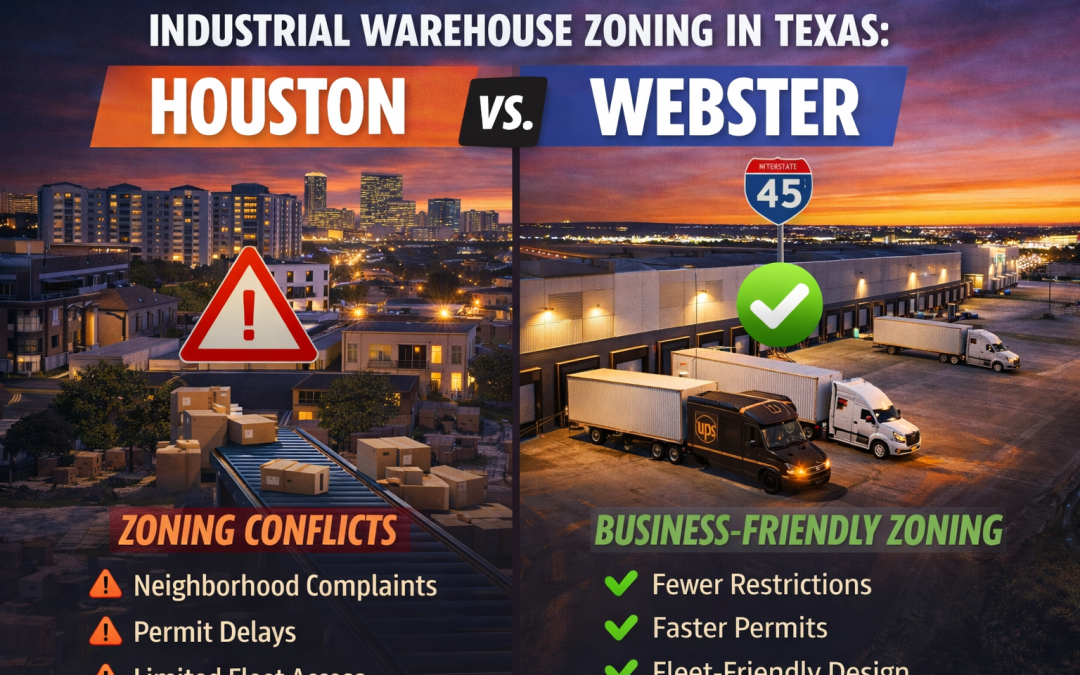
This is why zoning has become one of the most important decision factors when businesses compare Houston vs. Webster industrial warehouse locations.
This article explains how industrial warehouse zoning actually works in Texas, how Houston and Webster differ in practice, and why many business owners now view Webster as the lower-risk, business-friendly choice.
🏢 Industrial Warehouse for Rent
Explore premium warehouse space in Webster, TX — ideal for logistics, manufacturing, and distribution businesses.
View ListingZoning in Texas: The Reality Most Businesses Miss
Texas is often described as “business-friendly,” but zoning rules still exist—and they vary significantly by city.
What matters is not state law alone, but:
- City ordinances
- Enforcement style
- Neighborhood proximity
- Historical land use
Two warehouses labeled “industrial” can operate under very different constraints depending on location.
Houston’s Zoning Reality: Flexible on Paper, Complicated in Practice
Houston is unique because it does not use traditional zoning in the same way as other major cities. Instead, it relies on:
- Deed restrictions
- Permitting controls
- Ordinances
- Neighborhood influence
This system sounds flexible, but for industrial warehouse tenants, it often creates uncertainty.
Common Zoning Challenges in Houston
- Noise complaints from nearby residential areas
- Restrictions on early or late operations
- Limits on fleet parking
- Signage restrictions
- Permit delays for equipment or modifications
Many business owners discover these issues after moving in.
Mixed-Use Expansion Creates Conflict
As Houston grows, industrial zones are increasingly surrounded by:
- Apartments
- Retail developments
- Office parks
This creates friction.
Warehouses that were once isolated now face:
- Increased scrutiny
- Neighborhood complaints
- Operational restrictions
Even when technically allowed, enforcement pressure can make operations difficult.
Webster’s Zoning Environment: Clearer and More Predictable
Webster uses a more traditional zoning framework, which offers clarity and consistency for industrial businesses.
Industrial areas in Webster are generally:
- Clearly defined
- Separated from dense residential zones
- Designed for ongoing industrial activity
This reduces the risk of:
- Unexpected restrictions
- Complaints
- Operational disruptions
For businesses searching for an industrial warehouse for rent in Webster TX, zoning predictability is a major advantage.
What Webster Industrial Zoning Typically Supports
While specific properties must always be verified, Webster industrial zones commonly allow:
- Manufacturing and light industrial use
- Logistics and distribution operations
- Contractor fleet storage
- Equipment staging
- Flexible operating hours
This makes Webster particularly attractive for:
- Contractors
- Fleet-based businesses
- Manufacturers
- Fulfillment and logistics companies
Permitting & Modifications: Where Time Is Lost
Many warehouse tenants need to:
- Add electrical capacity
- Install equipment
- Modify interior layouts
- Improve loading areas
In Houston, these changes can involve:
- Multiple approvals
- Delays
- Inconsistent enforcement
Webster typically offers:
- Faster permit processes
- Clearer requirements
- Less back-and-forth
Time saved here directly reduces downtime and startup costs.
Fleet Parking & Vehicle Storage Rules
Fleet storage is one of the most common zoning pain points.
Houston warehouses often face:
- Restrictions on outdoor vehicle parking
- Complaints from surrounding properties
- Pressure to reduce visible fleet presence
Webster’s industrial zones are more accommodating of:
- Work vehicles
- Trailers
- Service fleets
This makes Webster ideal for contractor and service businesses.
Noise, Equipment & Operating Hours
Industrial operations create noise—this is unavoidable.
Houston’s proximity to residential growth increases:
- Noise sensitivity
- Enforcement pressure
- Operational limitations
Webster’s industrial zoning offers:
- Greater tolerance for equipment noise
- Fewer conflicts with residential neighbors
- More operational freedom
This is critical for early-start or late-finish operations.
Zoning Risk = Financial Risk
Zoning issues rarely shut businesses down immediately—but they chip away at efficiency.
Zoning friction leads to:
- Operational delays
- Legal consultations
- Forced adjustments
- Stress and uncertainty
Webster’s clarity reduces this risk, allowing businesses to operate with confidence.
Houston vs. Webster Zoning Comparison
| Zoning Factor | Houston | Webster |
|---|---|---|
| Predictability | Low | High |
| Residential Conflicts | Common | Limited |
| Fleet Storage | Often Restricted | More Flexible |
| Noise Tolerance | Lower | Higher |
| Permit Speed | Slower | Faster |
| Operational Freedom | Variable | Stable |
Why Businesses Factor Zoning Earlier Now
As operations become faster and margins tighter, businesses can no longer afford zoning surprises.
Many companies now evaluate zoning before rent, especially when comparing Houston and Webster.
Webster consistently emerges as the lower-risk choice.
Webster Supports Growth Without Interference
Zoning should support growth—not limit it.
Webster allows businesses to:
- Expand operations
- Increase fleet size
- Add equipment
- Adjust schedules
…without triggering constant compliance concerns.
Final Thought: Zoning Is Not a Technical Detail — It’s a Strategy
Choosing a warehouse is not just about space. It is about freedom to operate.
An industrial warehouse in Webster TX offers:
- Clear zoning
- Predictable enforcement
- Lower operational risk
For businesses that want stability and growth, Webster is becoming the obvious choice
FAQ
Does Webster have strict industrial zoning?
No. Webster zoning is clearer and more predictable than Houston’s mixed framework.
Can I operate equipment in a Webster warehouse?
In most industrial zones, yes—verify property-specific allowances.
Are fleet vehicles allowed at Webster warehouses?
Typically yes, making Webster ideal for contractors and service businesses.
Is Houston zoning risky for warehouses?
It can be, especially near mixed-use or residential growth areas.