
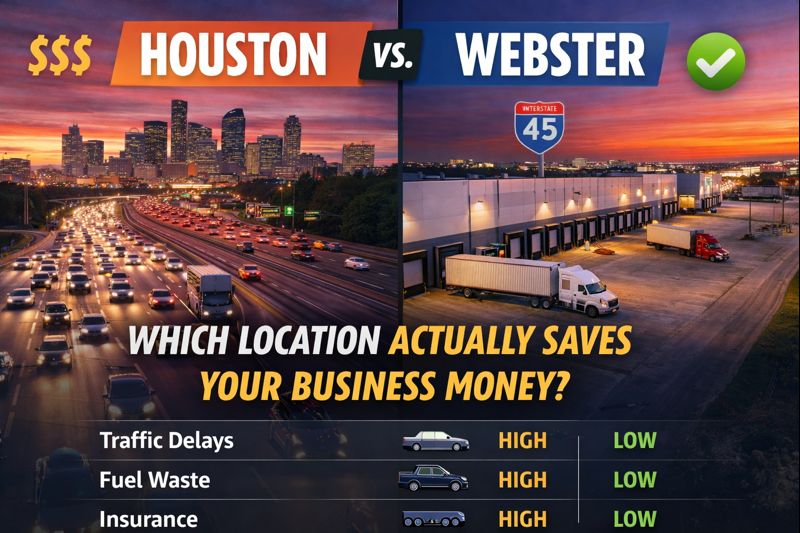
When businesses compare warehouse options, the conversation almost always starts with rent. Houston is often assumed to be more expensive, while Webster is seen as a cheaper alternative. But this framing misses the most important question entirely.
The real question is not “Which warehouse has lower rent?”
It is “Which warehouse costs less to operate?”
For logistics, manufacturing, distribution, and contractor businesses, monthly rent is only a fraction of the total cost of running a warehouse. Traffic delays, insurance, employee turnover, fuel waste, downtime, and regulatory friction quietly erode margins long after the lease is signed.
This article provides a clear, operational comparison of Houston vs. Webster industrial warehouses, showing where the real costs come from—and why so many business owners are choosing Webster.
🏢 Industrial Warehouse for Rent
Explore premium warehouse space in Webster, TX — ideal for logistics, manufacturing, and distribution businesses.
View ListingThe Illusion of Cheap Rent in Houston
At first glance, some Houston industrial warehouses appear competitively priced. Listings may show similar or even slightly lower base rent compared to Webster properties.
But experienced operators know that base rent is the least reliable indicator of total cost.
Houston warehouses often come with:
- Higher insurance premiums
- Increased fuel consumption
- Lost productivity from congestion
- Overtime pay due to delays
- Higher employee turnover
These costs do not appear on listings—but they appear every month on financial statements.
Traffic: The Most Expensive Hidden Cost
Traffic is the single largest operational difference between Houston and Webster warehouses.
Houston Warehouses
- Daily congestion during peak hours
- Unpredictable travel times
- Delivery windows missed
- Driver overtime
- Increased accident exposure
Webster Warehouses
- Faster highway access
- Predictable routes
- Reduced idle time
- More reliable scheduling
Every minute a truck sits in traffic is a cost. Over weeks and months, this becomes one of the largest operational expenses—often larger than rent differences.
Fuel, Fleet & Vehicle Wear
Fleet-based businesses feel this difference immediately.
Houston traffic causes:
- Excessive idling
- Stop-and-go wear
- Higher maintenance costs
- Shorter vehicle lifespan
Webster’s smoother access reduces:
- Fuel waste
- Brake and engine wear
- Maintenance downtime
For businesses running multiple vehicles, Webster warehouses reduce fleet costs significantly over time.
Insurance Costs: Quiet but Powerful
Insurance premiums are influenced by:
- Accident frequency
- Traffic density
- Property access
- Fire and emergency response
Houston industrial zones often carry higher risk profiles, which leads to higher insurance premiums.
Webster warehouses typically benefit from:
- Lower congestion
- Modern infrastructure
- Reduced incident exposure
These differences compound year after year.
Labor Costs & Employee Retention
Employee turnover is one of the most expensive costs in industrial operations.
Houston warehouse locations often mean:
- Long, stressful commutes
- Unreliable arrival times
- Higher absenteeism
- Faster burnout
Webster offers:
- Shorter commutes
- Easier access
- Less daily stress
Many businesses report improved attendance and retention after relocating to Webster—reducing hiring, training, and productivity losses.
Zoning & Compliance Costs
Houston’s zoning environment is complex and unpredictable.
Businesses often encounter:
- Unexpected restrictions
- Permit delays
- Operational limitations
- Compliance headaches
Webster provides a more stable and business-friendly zoning framework, reducing:
- Legal costs
- Delays
- Operational uncertainty
Stability equals savings.
Warehouse Design Efficiency
Houston warehouses—especially older buildings—often suffer from:
- Poor truck access
- Inefficient layouts
- Low ceiling heights
- Outdated utilities
Webster industrial warehouses are more likely to offer:
- Modern layouts
- Efficient loading
- Practical clear heights
- Flexible interiors
Efficiency reduces wasted space, time, and money.
Expansion & Relocation Costs
When businesses outgrow Houston warehouses, relocation is often painful:
- Higher rents
- Employee loss
- Disruption
Webster allows businesses to:
- Scale within the same area
- Transition smoothly
- Maintain workforce stability
This long-term flexibility is a major cost advantage.
Real Cost Comparison Summary
| Cost Factor | Houston | Webster |
|---|---|---|
| Traffic Delays | High | Low |
| Fuel Waste | High | Lower |
| Insurance | Higher | Lower |
| Employee Turnover | Higher | Lower |
| Zoning Friction | Complex | Simpler |
| Scalability | Difficult | Easier |
| Total Cost of Operation | Higher | Lower |
Why Businesses Choose Webster After Trying Houston
Most businesses that move to Webster do so after experiencing Houston’s inefficiencies firsthand.
They are not chasing trends. They are protecting margins.
Webster warehouses allow businesses to:
- Operate predictably
- Control costs
- Reduce daily stress
- Focus on growth
Webster Is Not Cheaper—It’s Smarter
The decision between Houston and Webster is not about cutting corners. It is about choosing an environment that supports execution.
An industrial warehouse for rent in Webster TX delivers:
- Lower total operating cost
- Higher efficiency
- Better employee stability
- Long-term scalability
For businesses that care about performance, the choice becomes clear.
EXTREMELY DETAILED FAQ
Is Webster really cheaper than Houston for warehouses?
In total operating cost—yes. Even when rent is similar, Webster reduces hidden expenses.
Does Webster work for Houston-based customers?
Yes. Faster, more predictable access often outperforms central Houston locations.
Are Webster warehouses suitable for fleets?
Absolutely. Yard access and traffic conditions are ideal for fleet operations.
Is zoning easier in Webster?
Yes. Webster offers fewer surprises and clearer industrial allowances.